Bachelor of Nutrition and Health Science
University of New England
CRICOS 119077B · Provider 00003G
at University of New South Wales · Sydney, New South Wales
CRICOS course code
109397B
CRICOS provider code
00098G
This course is registered on the Commonwealth Register of Institutions and Courses for Overseas Students. Verify it yourself at cricos.education.gov.au before paying any fee.
Duration
5 years
Tuition (whole course)
A$322,000 total
Per year
A$64,400/yr
Intake
Semester 1 (Feb/Mar), Semester 2 (Jul)
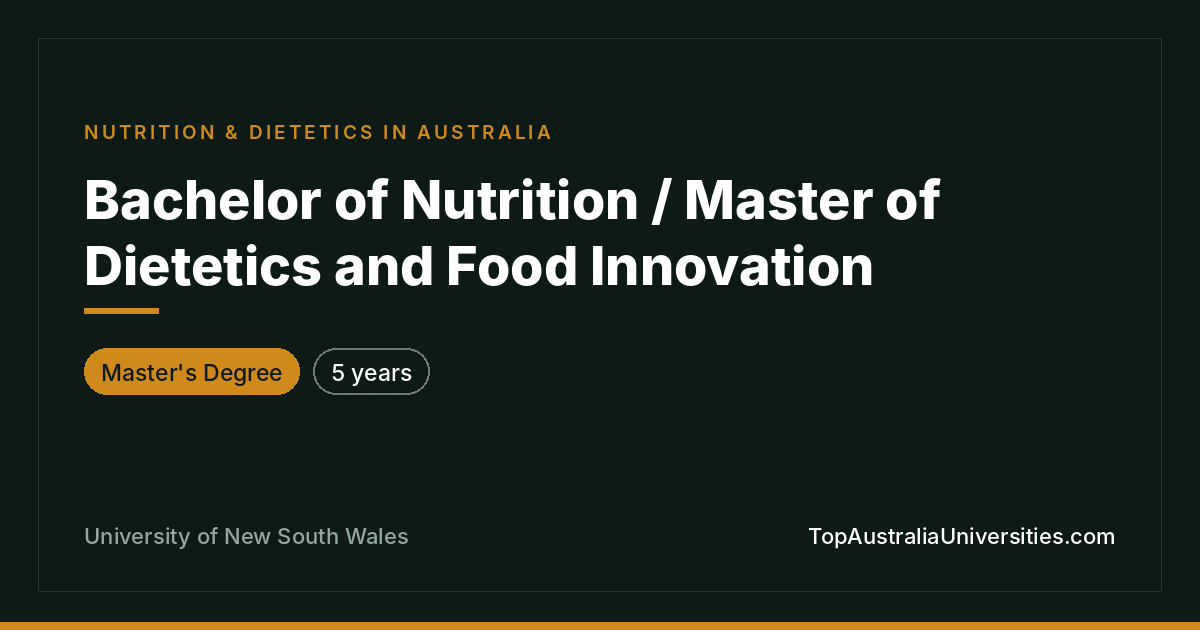
The Bachelor of Nutrition / Master of Dietetics and Food Innovation at the University of New South Wales integrates foundational knowledge with advanced professional training, preparing graduates for impactful roles in nutrition and dietetics. Over five years of full-time study in Sydney, students first build a solid grounding in human biology, biochemistry, and nutrition science through the undergraduate component, followed by comprehensive coursework and practical learning focused on dietetic practice and food innovation at the master's level.
Australian qualifications of this type combine sequenced units of study, each contributing set credit points towards graduation. The bachelor's stage is structured to provide essential scientific literacy and nutrition theory, while the master's comprises advanced units in clinical and community dietetics, food service management, and nutrition research. Students complete a capstone research project, exploring contemporary issues in food innovation or public health nutrition, fostering high-level critical thinking and investigative skills.
Significant emphasis is placed on practical, real-world experience. As part of the master's component, students undertake work-integrated learning placements in hospitals, community health settings, or the food industry, immersing them in Australia's diverse nutrition landscape and enabling them to graduate workforce-ready. Throughout the programme, students develop strong communication, leadership, and problem-solving abilities, positioning them for success in dynamic professional environments.
This double degree suits those seeking a comprehensive education leading to qualification as a dietitian, as well as those aspiring to innovate within the evolving food sector. International students benefit from Sydney's vibrant food and healthcare industries, and may be eligible for post-study work rights under the Temporary Graduate visa (subclass 485). During study, international students can access work rights of up to 48 hours per fortnight. Detailed information about entry requirements, including English language proficiency, is available on the official programme page.

Australian graduates are sought after in healthcare, aged care, sports, food manufacturing, and public health sectors. Always consult the official programme page for accreditation and industry placement details specific to Australia.
It typically takes 5 years, with intakes in Semester 1 (Feb/Mar), Semester 2 (Jul).
Tuition is around A$322,000 total. Fees change yearly, confirm with an advisor.
Accredited Practising Dietitian (in healthcare, community, or private practice)Food product development specialist in the food and beverage industryNutrition policy advisor within government agenciesPublic health nutritionist with non-government organisationsResearcher in food in...
Application Guides How to Apply to an Australian University: ATAR, UAC and Direct Applications
Domestic school leavers apply through a state admissions centre; international applicants apply directly to the university. This is the whole path, from entry requirements to Letter of Offer and Confirmation of Enrolment.
Rankings & Comparisons Group of Eight or Technology University? Choosing the Right Australian Institution
The Go8 research universities, the technology network, the regional universities and the private providers each suit a different student. How to tell which one suits you.
Student Visa Student Visa Subclass 500 Refusals: The Reasons That Come Up Most
Most subclass 500 refusals trace back to four things: the Genuine Student requirement, funds evidence, course-progression logic, or an incomplete CoE. Here's what each one actually means and how to fix it before you apply.
University of New England
CRICOS 119077B · Provider 00003G
Australian Catholic University
CRICOS 0101322 · Provider 00004G
Australian Catholic University
CRICOS 0101324 · Provider 00004G
Australian Catholic University
CRICOS 094690B · Provider 00004G
Australian Catholic University
CRICOS 095926A · Provider 00004G
Australian Catholic University
CRICOS 106764H · Provider 00004G