Master's Degree
Information Technology
MA

CRICOS 0101509 · Provider 00002J
⏱ 3 years 🎓 Full Time
💰 A$147,400 total
 Study in Australia
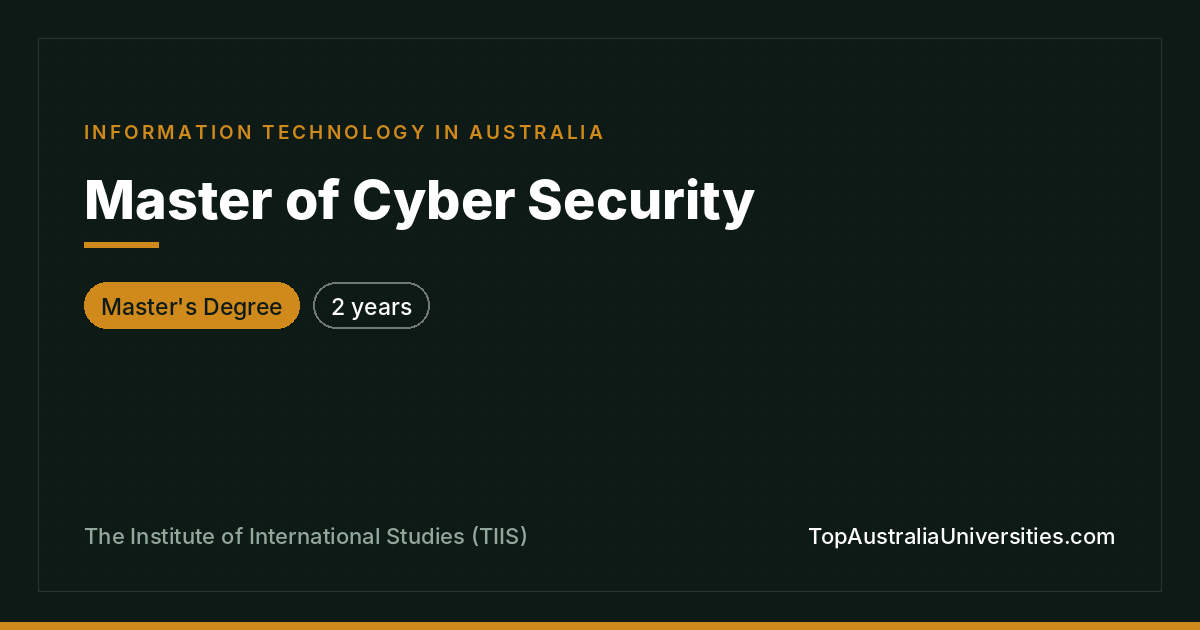

at The Institute of International Studies (TIIS) · Sydney, New South Wales
CRICOS course code
115211M
CRICOS provider code
03705J
This course is registered on the Commonwealth Register of Institutions and Courses for Overseas Students. Verify it yourself at cricos.education.gov.au before paying any fee.
Duration
2 years
Tuition (whole course)
A$47,200 total
Per year
A$23,600/yr
Intake
Semester 1 (Feb/Mar), Semester 2 (Jul)
The Master of Cyber Security at The Institute of International Studies (TIIS) is a two-year postgraduate degree for people who want to work on the defensive side of computing: securing networks, systems and data, and responding when something goes wrong. You will study areas such as network security, cryptography, digital forensics, security governance and risk, and the legal and ethical rules that shape how organisations handle breaches and personal information. Teaching mixes theory with hands-on work in labs and projects, so you spend time configuring and testing systems rather than only reading about them.
As a master's degree, this course sits at Level 9 of the Australian Qualifications Framework. It is normally two years of full-time study, delivered across semesters or trimesters. You complete a set of core units in cyber security and related IT fields, choose electives to shape your specialisation, and finish with a capstone project or research thesis where you apply what you have learned to a real problem. Each unit carries a credit point value, and you need to pass the required number of credit points to graduate. Some students with a relevant bachelor's degree may be able to reduce the duration through credit for prior study, but that is assessed case by case and you should confirm the details with TIIS.
Graduates leave able to assess security risks, design and maintain secure systems, investigate incidents, and communicate findings to both technical and non-technical audiences. You learn to work with security tools and frameworks, analyse threats, and apply standards and regulations that Australian organisations must follow. Group work and presentations build the consulting and reporting skills that security roles demand, because in practice you rarely work alone.
This course suits IT professionals who want to move into security, career changers with a technical background, and recent graduates in computing or a related discipline who want deeper specialist knowledge. It also works for people in risk, audit or compliance who need a stronger technical grounding. If you are an international student, you can work up to 48 hours per fortnight while your course is in session, and after graduating you may be eligible for the Temporary Graduate visa (subclass 485) post-study work stream. English requirements are published by TIIS; the Student visa has its own separate English threshold set by the Department of Home Affairs. Tuition and intake details are on the CRICOS register and the official TIIS page, check those before you apply.
Demand for security skills is strong across Australian banking, government, healthcare, defence and technology, and the field is short of experienced people. Many roles require a security clearance or police check, so plan for that early.
It typically takes 2 years, with intakes in Semester 1 (Feb/Mar), Semester 2 (Jul).
Tuition is around A$47,200 total. Fees change yearly, confirm with an advisor.
Cyber security analyst, monitoring networks, investigating alerts and improving defences in banks, insurers, government agencies and managed security providers.Security engineer, building and maintaining secure infrastructure for technology companies, telecommunications firms and...
 Application Guides How to Apply to an Australian University: ATAR, UAC and Direct Applications
Domestic school leavers apply through a state admissions centre; international applicants apply directly to the university. This is the whole path, from entry requirements to Letter of Offer and Confirmation of Enrolment.
Application Guides How to Apply to an Australian University: ATAR, UAC and Direct Applications
Domestic school leavers apply through a state admissions centre; international applicants apply directly to the university. This is the whole path, from entry requirements to Letter of Offer and Confirmation of Enrolment.
 Rankings & Comparisons Group of Eight or Technology University? Choosing the Right Australian Institution
The Go8 research universities, the technology network, the regional universities and the private providers each suit a different student. How to tell which one suits you.
Rankings & Comparisons Group of Eight or Technology University? Choosing the Right Australian Institution
The Go8 research universities, the technology network, the regional universities and the private providers each suit a different student. How to tell which one suits you.
 Student Visa Student Visa Subclass 500 Refusals: The Reasons That Come Up Most
Most subclass 500 refusals trace back to four things: the Genuine Student requirement, funds evidence, course-progression logic, or an incomplete CoE. Here's what each one actually means and how to fix it before you apply.
Student Visa Student Visa Subclass 500 Refusals: The Reasons That Come Up Most
Most subclass 500 refusals trace back to four things: the Genuine Student requirement, funds evidence, course-progression logic, or an incomplete CoE. Here's what each one actually means and how to fix it before you apply.
CRICOS 0101509 · Provider 00002J
Macquarie University
CRICOS 047327M · Provider 00002J
Macquarie University
CRICOS 080284J · Provider 00002J
Macquarie University
CRICOS 083790M · Provider 00002J
Macquarie University
CRICOS 090742E · Provider 00002J
Macquarie University
CRICOS 095021J · Provider 00002J