Bachelor of Music (Composition) at AIM
AI The Australian Institute of Music logo
Bachelor's Degree Music Full Time

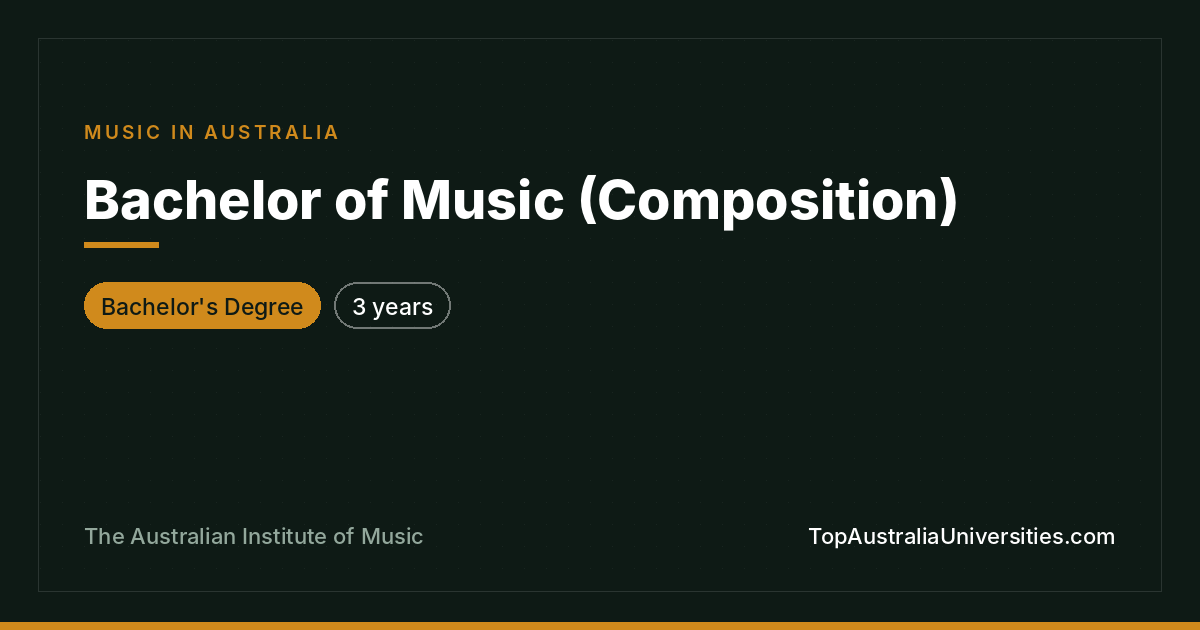
Bachelor of Music (Composition)

at The Australian Institute of Music · The Rocks, New South Wales

CRICOS course code

111590E

CRICOS provider code

00665C

This course is registered on the Commonwealth Register of Institutions and Courses for Overseas Students. Verify it yourself at cricos.education.gov.au before paying any fee.

Duration

3 years

Tuition (whole course)

A$81,648 total

Per year

A$27,216/yr

Intake

Semester 1 (Feb/Mar), Semester 2 (Jul)

About this program

The Bachelor of Music (Composition) at The Australian Institute of Music (AIM) is a three-year degree for people who want to write music, for film, games, concert halls, or their own projects. You spend your time composing, not just talking about it. Expect to work on original scores, learn notation and sequencing software, study harmony and orchestration, and have your pieces played and recorded by other musicians. AIM is a music specialist institution, so your classmates are performers, producers and songwriters, and collaboration is part of the daily routine.

How the degree is structured

Australian bachelor degrees are made up of units of study, each worth credit points. You need a set number of credit points to graduate, usually spread across three years of full-time study. AIM runs its calendar in trimesters, which means three study periods a year rather than two. That pace suits composers, you get more starts and more chances to finish a piece, and you can often pick up extra units if you want to move faster. The first year builds your fundamentals: music theory, aural skills, keyboard, and music technology. Later years let you specialise in areas like screen composition, contemporary classical writing, or arranging, with electives to shape the degree around your interests.

Capstone and work-integrated learning

Most Australian music degrees finish with a capstone project. At AIM this typically means a major composition portfolio, a substantial body of original work, presented and defended. You might write for a small ensemble, score a short film, or produce a set of electronic works. Because AIM sits inside the music industry, work-integrated learning is built in: you may collaborate with film students, write for AIM ensembles, or take on real briefs from external clients. Many students also do a professional placement with a production house, a recording studio, or a music publisher. These experiences count toward your degree and give you something concrete for your showreel.

Skills you gain

By the end you can notate and produce music to a professional standard, work with directors and performers, meet deadlines, and give and take feedback on creative work. You learn to analyse music across styles, use industry software, and manage a project from first idea to final master. You also build the habits of a working composer: turning up, finishing things, and building a network. Australian institutions describe this as graduate attributes, the mix of technical skill and professional behaviour employers expect.

Who it suits

This degree suits school leavers with a strong music background, mature students returning to study, and performers who want to write their own material. You do not need to be a virtuoso, but you do need to read music or be willing to learn fast. If you are an international student, you will need to meet English requirements, IELTS Academic 6.0–6.5 overall is the usual undergraduate standard, with TOEFL, PTE and Cambridge C1 Advanced accepted as equivalents. The Student visa has its own English threshold set by the Department of Home Affairs. While you study, you can work up to 48 hours per fortnight. After graduating, the Temporary Graduate visa (subclass 485) post-study work stream may let you stay and work in Australia, depending on your circumstances. Tuition is published on the CRICOS register under course code 111590E. Check the official AIM page for current unit lists, audition requirements and intake dates.

Entry requirements

English: International applicants must evidence English proficiency. IELTS Academic 6.0–6.5 overall is the common undergraduate and coursework-postgraduate standard, rising to 7.0–7.5 for teaching, nursing, medicine, law and social work. TOEFL iBT, PTE Academic, Cambridge C1 Advanced and the university’s own English programmes are accepted as equivalents; the Department of Home Affairs sets a separate English threshold for the Student visa itself.
International students: Registered on CRICOS for international students. A Confirmation of Enrolment (CoE) for this course supports a Student visa (subclass 500) application; Overseas Student Health Cover is required for the full duration.

Career outcomes

  • Composer for screen and games, writing original scores for film, television, streaming, advertising and interactive media. Australia has a growing screen sector, with production companies in Sydney, Melbourne, Brisbane and the Gold Coast regularly hiring composers on a project basis.
  • Songwriter or topline writer, collaborating with artists, producers and publishers. Australasian Performing Right Association (APRA AMCOS) represents writers and publishers here, and many AIM graduates work across pop, country, electronic and sync licensing.
  • Arranger or orchestrator, preparing music for ensembles, recording sessions and live shows. Work comes from orchestras, musical theatre, recording studios and event producers.
  • Music producer or beatmaker, producing tracks for other artists, often in home or commercial studios. The Australian music industry includes labels, management companies and independent artist services.
  • Library or production music writer, writing instrumental cues for music libraries used in TV, film, YouTube and corporate video. This is a common entry point for composers building a catalogue.
  • Music director or repetiteur, working in musical theatre, community music and church music, preparing and directing ensembles.
  • Arts administrator or music educator, roles in arts organisations, community music programs, schools and conservatoriums. Further study in teaching is usually required for school teaching.
  • Freelance composer and performer, combining your own creative practice with session work, teaching and commissions. Most composers in Australia work across several of these roles at once.

Frequently asked questions

How long is the Bachelor of Music (Composition) at The Australian Institute of Music?

It typically takes 3 years, with intakes in Semester 1 (Feb/Mar), Semester 2 (Jul).

How much is the tuition?

Tuition is around A$81,648 total. Fees change yearly, confirm with an advisor.

What are the career outcomes?

Composer for screen and games, writing original scores for film, television, streaming, advertising and interactive media. Australia has a growing screen sector, with production companies in Sydney, Melbourne, Brisbane and the Gold Coast regularly hiring composers on a project ba...

Guides for this subject and the application

All guides →

Related programs

Bachelor's Degree Music
MA Macquarie University logo

Bachelor of Music

Macquarie University

CRICOS 099148F · Provider 00002J

⏱ 3 years 🎓 Full Time 💰 A$128,500 total
Bachelor Honours Degree Music
UN University of New England logo

Bachelor of Music with Honours

University of New England

CRICOS 093388E · Provider 00003G

⏱ 1 year 🎓 Full Time 💰 A$30,480 total
PhD / Doctorate Music
MO Monash University logo

Doctor of Philosophy (Music)

Monash University

CRICOS 0101965 · Provider 00008C

⏱ 4 years 🎓 Full Time 💰 A$201,232 total
Bachelor's Degree Music
MO Monash University logo

Bachelor of Music

Monash University

CRICOS 017113G · Provider 00008C

⏱ 3 years 🎓 Full Time 💰 A$125,752 total