Bachelor of Hospitality Management
Holmesglen, Holmesglen Institute
CRICOS 089800K · Provider 00012G
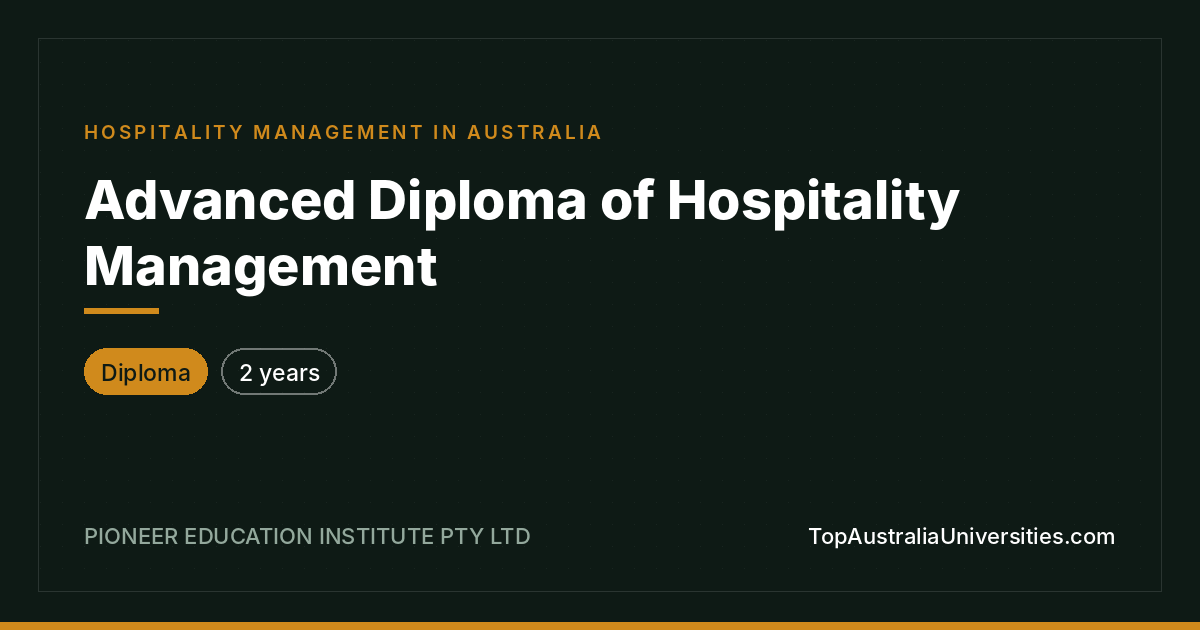
at PIONEER EDUCATION INSTITUTE PTY LTD · Perth, Western Australia
CRICOS course code
111120B
CRICOS provider code
03956A
This course is registered on the Commonwealth Register of Institutions and Courses for Overseas Students. Verify it yourself at cricos.education.gov.au before paying any fee.
Duration
2 years
Tuition (whole course)
A$30,000 total
Per year
A$15,000/yr
Intake
Semester 1 (Feb/Mar), Semester 2 (Jul)
The Advanced Diploma of Hospitality Management is a two-year qualification that prepares you to run the show in hotels, restaurants, events and resorts. You learn how to manage a food and beverage outlet, plan and monitor budgets, lead a team, manage compliance with health and safety rules, and handle the legal side of running a venue. There is also a strong practical thread: you work in commercial kitchens and service areas, plan events, and learn how to roster staff and control stock. The course is built around units of study, each with a set credit point value, and you can expect a mix of classroom sessions, kitchen and restaurant shifts, and written assessments.
Australian qualifications like this sit on the Australian Qualifications Framework. An advanced diploma is a two-year course, usually delivered over four or five study periods, with each unit contributing to the total credit points needed to graduate. At Pioneer Education Institute, the focus is on getting you ready for a supervisory or management role, so assessment is often based on real workplace tasks. Some providers include a work placement or industry internship as part of the course, and you should check the official page to see whether that applies here.
You will gain skills in rostering, budgeting, customer service, team leadership, and compliance. You also learn how to handle complaints, manage suppliers, and use hospitality software for bookings and stock control. The course suits people who want to move into a management role, or who already work in hospitality and want a formal qualification to step up. It is also a good fit if you enjoy working with people and want a practical, hands-on qualification rather than a purely academic degree.
International students in Australia can work up to 48 hours per fortnight while studying, which is a real advantage if you want to pick up shifts in a hotel or café while you study. After you finish, you may be eligible for the Temporary Graduate visa (subclass 485) post-study work stream, which lets you stay and work in Australia. Always confirm the details on the official CRICOS page and with the provider, because entry requirements and course structure can change.

These roles are found across Australia in hotels, resorts, restaurants, pubs, clubs, event companies and catering firms. The advanced diploma also gives you a pathway into further study, such as a bachelor degree in hospitality management, with credit for your completed units.
It typically takes 2 years, with intakes in Semester 1 (Feb/Mar), Semester 2 (Jul).
Tuition is around A$30,000 total. Fees change yearly, confirm with an advisor.
Restaurant or café manager – running daily operations, managing staff and budgets in venues across Australia.Hotel front office supervisor – overseeing reception, reservations and guest services in hotels and resorts.Food and beverage supervisor – leading service teams in restaur...
Application Guides How to Apply to an Australian University: ATAR, UAC and Direct Applications
Domestic school leavers apply through a state admissions centre; international applicants apply directly to the university. This is the whole path, from entry requirements to Letter of Offer and Confirmation of Enrolment.
Rankings & Comparisons Group of Eight or Technology University? Choosing the Right Australian Institution
The Go8 research universities, the technology network, the regional universities and the private providers each suit a different student. How to tell which one suits you.
Student Visa Student Visa Subclass 500 Refusals: The Reasons That Come Up Most
Most subclass 500 refusals trace back to four things: the Genuine Student requirement, funds evidence, course-progression logic, or an incomplete CoE. Here's what each one actually means and how to fix it before you apply.
Holmesglen, Holmesglen Institute
CRICOS 089800K · Provider 00012G
Holmesglen, Holmesglen Institute
CRICOS 114778B · Provider 00012G
University of Queensland
CRICOS 103153D · Provider 00025B
TAFE South Australia
CRICOS 090981A · Provider 00092B
TAFE South Australia
CRICOS 091139E · Provider 00092B
TAFE South Australia
CRICOS 114652E · Provider 00092B