Bachelor of Social Work
University of New England
CRICOS 064581M · Provider 00003G
at Australian Health and Science Institute Pty Ltd · Sydney, New South Wales
CRICOS course code
089594M
CRICOS provider code
03222F
This course is registered on the Commonwealth Register of Institutions and Courses for Overseas Students. Verify it yourself at cricos.education.gov.au before paying any fee.
Duration
2 years
Tuition (whole course)
A$28,000 total
Per year
A$14,000/yr
Intake
Semester 1 (Feb/Mar), Semester 2 (Jul)
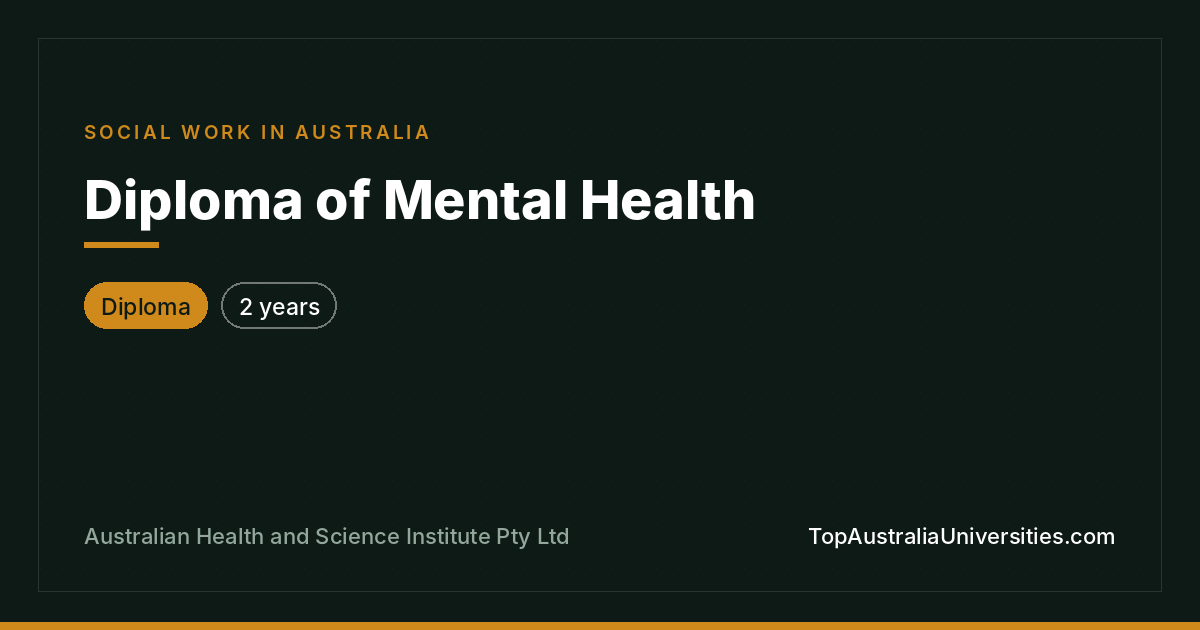
The Diploma of Mental Health is a two-year qualification that trains you to work directly with people who live with mental health issues. You'll study subjects like mental health law and ethics, trauma-informed care, counselling and communication skills, crisis intervention, and how to support recovery and community participation. The course also covers the Australian mental health system, including how to work with families, carers and other services.
As a diploma, this course sits at AQF level 5. It's usually delivered over two years, with units of study and credit points that build toward a qualification that's recognised across Australia. You'll spend time in both classroom and practical settings. Many diplomas include a work placement or simulated work environment, so you get real experience before you graduate. Assessment is based on the units you complete, and you'll need to pass all required units to receive the diploma.
You'll learn how to assess a person's needs, develop support plans, and provide emotional and practical support. You'll also learn how to work within legal and ethical boundaries, communicate with people in distress, and collaborate with other health professionals. The course covers mental health conditions, treatments, and the social factors that affect wellbeing. You'll practise skills like active listening, de-escalation, and record-keeping.
This diploma suits people who want to start a career in mental health support, or those already working in the field who want a formal qualification. It's also a pathway to further study, such as a bachelor's degree in social work, psychology, or nursing. If you're patient, empathetic, and want to make a difference, this could be a good fit. The course is delivered by the Australian Health and Science Institute, and you should check the official CRICOS page for the most current details on fees, entry requirements, and English language standards.

Graduates find work in community mental health organisations, hospitals, residential care facilities, and government agencies. The diploma also provides a pathway into further study in social work, nursing, or psychology. In Australia, the mental health sector is growing, and there is demand for skilled support workers across the country. If you're an international student, you may be eligible for the Temporary Graduate visa (subclass 485) after your studies, which lets you work in Australia temporarily. While studying, you can work up to 48 hours per fortnight.
It typically takes 2 years, with intakes in Semester 1 (Feb/Mar), Semester 2 (Jul).
Tuition is around A$28,000 total. Fees change yearly, confirm with an advisor.
Mental health support workerCommunity rehabilitation workerPeer support workerCase worker in community servicesResidential support workerOutreach workerEmployment support workerFamily and carer support workerGraduates find work in community mental health organisations, hospitals,...
Application Guides How to Apply to an Australian University: ATAR, UAC and Direct Applications
Domestic school leavers apply through a state admissions centre; international applicants apply directly to the university. This is the whole path, from entry requirements to Letter of Offer and Confirmation of Enrolment.
Rankings & Comparisons Group of Eight or Technology University? Choosing the Right Australian Institution
The Go8 research universities, the technology network, the regional universities and the private providers each suit a different student. How to tell which one suits you.
Student Visa Student Visa Subclass 500 Refusals: The Reasons That Come Up Most
Most subclass 500 refusals trace back to four things: the Genuine Student requirement, funds evidence, course-progression logic, or an incomplete CoE. Here's what each one actually means and how to fix it before you apply.
University of New England
CRICOS 064581M · Provider 00003G
University of New England
CRICOS 084828E · Provider 00003G
Australian Catholic University
CRICOS 074604D · Provider 00004G
Australian Catholic University
CRICOS 084790C · Provider 00004G
Australian Catholic University
CRICOS 084791B · Provider 00004G
Australian Catholic University
CRICOS 105271D · Provider 00004G