Bachelor of Medical Radiation Science (Honours) | Adelaide
AD Adelaide University logo
Bachelor Honours Degree Medicine & Health Sciences Full Time

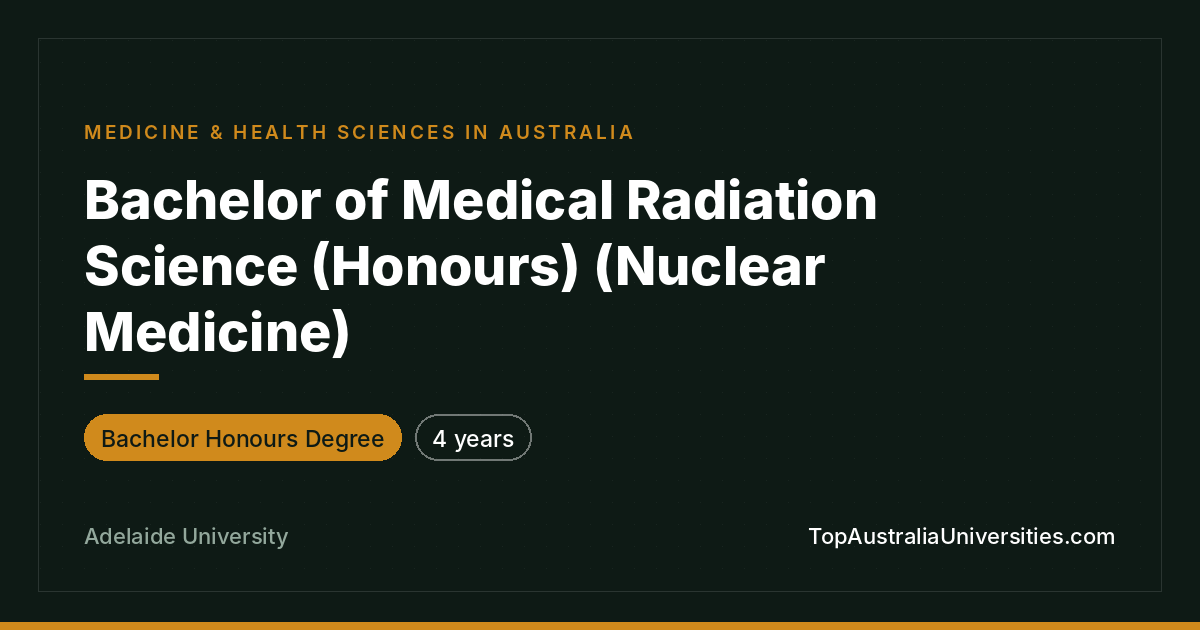
Bachelor of Medical Radiation Science (Honours) (Nuclear Medicine)

at Adelaide University · Adelaide, South Australia

CRICOS course code

088331J

CRICOS provider code

00121B

This course is registered on the Commonwealth Register of Institutions and Courses for Overseas Students. Verify it yourself at cricos.education.gov.au before paying any fee.

Duration

4 years

Tuition (whole course)

A$177,200 total

Per year

A$43,670/yr

Intake

Semester 1 (Feb/Mar), Semester 2 (Jul)

About this program

The Bachelor of Medical Radiation Science (Honours) (Nuclear Medicine) at Adelaide University is an intensive four-year honours degree designed for students interested in specialising in nuclear medicine within Australia's dynamic healthcare system. This course provides in-depth coverage of medical imaging principles, patient care, radiation safety, anatomy, pathology, and the scientific underpinnings of nuclear medicine technology. Through a mix of classroom-based learning, practical laboratory experience, and clinical placements in Australian healthcare settings, students develop the technical proficiency and analytical skills required for this specialist role.

Australian bachelor honours degrees typically involve structured semesters, with core and elective units of study contributing to a set number of credit points across the four years. This honours programme incorporates advanced coursework and a supervised research project or capstone, allowing students to investigate real-world clinical or research challenges in nuclear medicine, often in collaboration with industry or hospital partners.

The curriculum includes significant work-integrated learning through professional placements, which are fundamental for developing hands-on competencies in diagnostic and therapeutic nuclear medicine procedures. These placements provide exposure to diverse clinical environments and support the application of theory to practice, a crucial requirement for licensure and professional registration in Australia. Graduates are equipped with scientific expertise, strong communication and teamwork skills, and a commitment to ethical, patient-centred care.

This course is suited to school leavers and career changers who have a keen interest in science and healthcare, and who aspire to work in a technologically advanced, patient-focused sector. International students should note Australia's work rights, including opportunities to work up to 48 hours per fortnight during studies, and potential eligibility for the Temporary Graduate visa (subclass 485) in the post-study work stream. Applicants must demonstrate English proficiency as set by the university and the Department of Home Affairs. Always confirm specific entry requirements and course details on the official university website.

Entry requirements

English: International applicants must evidence English proficiency. IELTS Academic 6.0–6.5 overall is the common undergraduate and coursework-postgraduate standard, rising to 7.0–7.5 for teaching, nursing, medicine, law and social work. TOEFL iBT, PTE Academic, Cambridge C1 Advanced and the university’s own English programmes are accepted as equivalents; the Department of Home Affairs sets a separate English threshold for the Student visa itself.
International students: Registered on CRICOS for international students. A Confirmation of Enrolment (CoE) for this course supports a Student visa (subclass 500) application; Overseas Student Health Cover is required for the full duration.

Career outcomes

  • Nuclear Medicine Technologist in hospitals and private clinics
  • Medical Imaging Research Assistant
  • Specialist roles in radiopharmaceutical companies
  • Healthcare project management in public and private sectors
  • Quality assurance and regulatory roles in nuclear medicine
  • Opportunities within Australia's public and private healthcare, medical imaging, and research industries

Frequently asked questions

How long is the Bachelor of Medical Radiation Science (Honours) (Nuclear Medicine) at Adelaide University?

It typically takes 4 years, with intakes in Semester 1 (Feb/Mar), Semester 2 (Jul).

How much is the tuition?

Tuition is around A$177,200 total. Fees change yearly, confirm with an advisor.

What are the career outcomes?

Nuclear Medicine Technologist in hospitals and private clinicsMedical Imaging Research AssistantSpecialist roles in radiopharmaceutical companiesHealthcare project management in public and private sectorsQuality assurance and regulatory roles in nuclear medicineOpportunities with...

Guides for this subject and the application

All guides →

Related programs

Bachelor's Degree Medicine & Health Sciences
MA Macquarie University logo

Bachelor of Chiropractic Science

Macquarie University

CRICOS 028866G · Provider 00002J

⏱ 3 years 🎓 Full Time 💰 A$154,000 total
Master's Degree Medicine & Health Sciences
MA Macquarie University logo

Master of Advanced Surgery

Macquarie University

CRICOS 060660M · Provider 00002J

⏱ 1 year 🎓 Full Time 💰 A$20,000 total
Master's Degree Medicine & Health Sciences
MA Macquarie University logo

Master of Surgery

Macquarie University

CRICOS 060661K · Provider 00002J

⏱ 2 years 🎓 Full Time 💰 A$40,000 total
PhD / Doctorate Medicine & Health Sciences
MA Macquarie University logo

Doctor of Advanced Surgery

Macquarie University

CRICOS 077336F · Provider 00002J

⏱ 3 years 🎓 Full Time
Bachelor's Degree Medicine & Health Sciences
MA Macquarie University logo

Bachelor of Human Sciences

Macquarie University

CRICOS 080285G · Provider 00002J

⏱ 3 years 🎓 Full Time 💰 A$142,600 total